The Convenience Trap: 5 Password Threats Hidden in Your Productivity Shortcuts

In the race to scale a business, speed is everything. We use Slack for instant answers, browser auto-fill to save seconds on logins, and shared spreadsheets to keep the whole team moving. But there is a "convenience tax" that most teams don't realize they are paying. Many of the habits we adopt to work faster are the exact vulnerabilities that lead to modern password threats.
According to recent data, password-related vulnerabilities remain the primary cause of most data breaches. The goal isn't to stop being productive; it’s to bridge the gap between working fast and staying secure.
Table of Contents
The Productivity vs. Security Audit
Before diving into the specific attacks, look at your team’s current workflow. Are you accidentally inviting these password threats?
| The Shortcut (Utility) | The Hidden Risk (Security) | The Threat |
|---|---|---|
| "Ping me the login on Slack." | Plain-text passwords stay in chat history forever. | Spear Phishing |
| "Let's just use CompanyName2026!" | Predictable patterns are easily guessed by bots. | Brute Force |
| "Save my password in Chrome." | Browser-stored credentials can be intercepted. | Man-in-the-Middle |
| "I use this password for everything." | One minor leak compromises every single account. | Credential Stuffing |
1. The "Quick Ping" Trap: Spear Phishing
We’ve all done it: a teammate asks for a login, and you paste it into a DM or email to keep them moving. This is high utility, but it creates a massive target for Spear Phishing. Unlike generic spam, spear phishing is a targeted attack where a criminal impersonates a trusted source—like your CEO or a vendor—to gain access to those specific communication channels.
If an attacker gains access to one person's email or Slack, they don't just see the messages; they see the history. Every password ever shared in plain text becomes a "key" the hacker can now use. This is exactly how Twitter’s internal systems were breached by a teenager in 2020.
Deep Dive: How to spot and stop spear phishing attacks.
2. The "Remote Work" Shortcut: Man-in-the-Middle (MITM)
The "utility" here is the ability to work from anywhere—the airport, a coffee shop, or a co-working space. To stay productive, we often rely on public Wi-Fi and browser "remember me" features. A Man-in-the-Middle attack happens when a hacker intercepts the data passing between your device and the server.
If you are working on an unencrypted network or a site without HTTPS, your credentials can be "sniffed" out of the air. Even a "Remember Me" cookie can be hijacked to bypass login screens entirely. Modern password management prevents this by localizing the encryption, ensuring that even if data is intercepted, it remains unreadable gibberish.
Deep Dive: Understanding the Man-in-the-Middle architecture.
3. The "Easy to Remember" Habit: Brute Force
Humans are bad at remembering random strings of characters. To stay productive, we create "systematized" passwords like BrandName2026!. While this feels organized, it is the primary food source for Brute Force attacks.
Hackers use automated scripts that try thousands of variations of common words and patterns every second. If your username is public (like your email address) and your password follows a predictable pattern, it's only a matter of time before a bot finds the right combination. Using a password generator to create 32-character "noise" is the only way to truly neutralize this threat.
Deep Dive: Why your "strong" password isn't enough.
4. The "Universal Login": Credential Stuffing
This is the most common "productivity shortcut." Using the same password for your project management tool, your email, and your favorite pizza delivery app saves mental energy. However, it leads to Credential Stuffing.
When a minor site (like that pizza app) gets breached, hackers take the billions of leaked emails and passwords and "stuff" them into the login pages of more valuable targets like AWS, GitHub, or banking portals. If you reuse passwords, a breach at a company you haven't used in five years could lead to a breach of your current business today.
Deep Dive: From Appletree to Anarchy: The anatomy of credential stuffing.
5. The "Personal Touch": Dictionary Attacks
Dictionary attacks are a more refined version of brute force. Instead of trying every character, they use "personal" data to narrow the search. If a hacker knows your dog’s name (from Instagram) or your city (from LinkedIn), they add those to their "dictionary."
By using recognizable words or familiar phrases, you make the hacker's job exponentially easier. The "utility" of having a password you can actually remember is outweighed by the risk of that password being part of a common word-list.
Bridging the Gap with TeamPassword
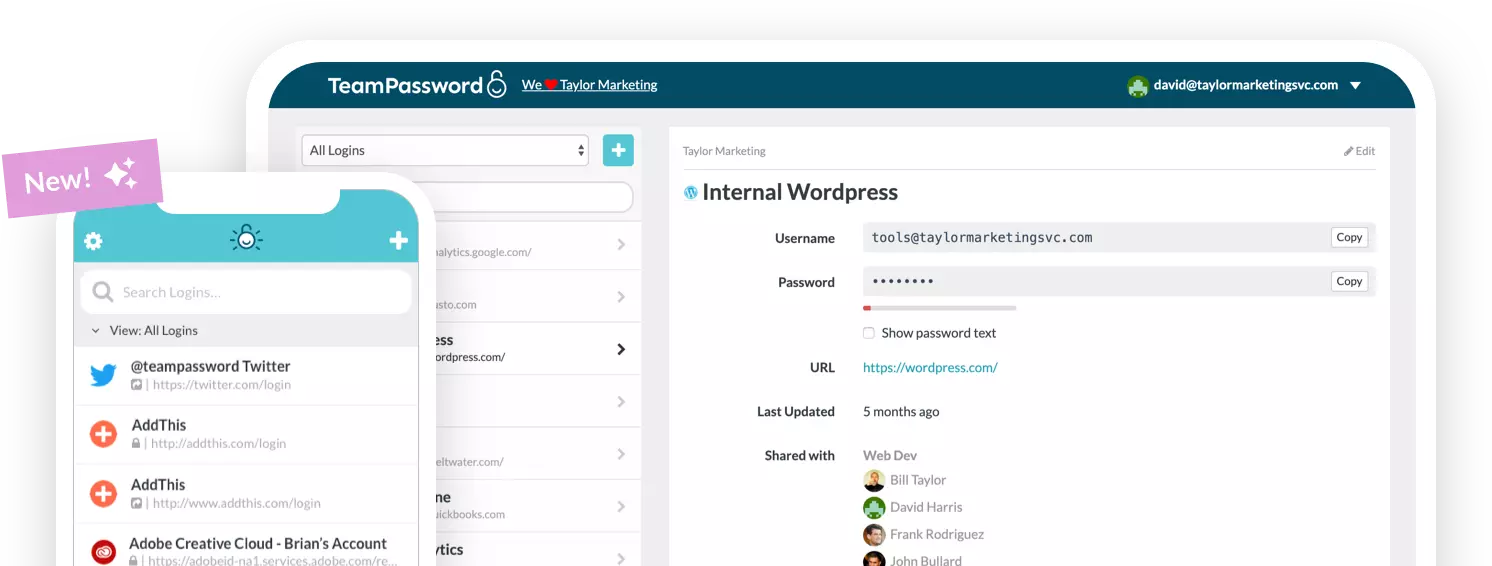
Security shouldn't be a speed bump. The reason teams use shortcuts like shared spreadsheets or recycled passwords is that traditional security feels slow. We designed TeamPassword to give you back that utility without the associated risks.
- 2FA Integration: Enforceable 2FA, requiring all users to provide a time-based code when logging into their vault.
- One-Click Access: Our browser extensions (Chrome, Firefox, Safari) allow your team to log in instantly, removing the temptation to use "remember me" shortcuts in the browser.
- Activity Logging: Instead of wondering who accessed what, you have a full audit trail to get ahead of suspicious activity.
You don't have to sacrifice your team's workflow to protect against password threats. You just need a better bridge.
Stop the convenience trap. Start your 14-day free trial and see how TeamPassword makes security as fast as your team.
おすすめの記事
The Ultimate Employee Offboarding Guide for Data Security
What’s the plan when an employee leaves? Properly handing off company information when an employee leaves can be ...
What is password encryption and how does it work?
Password encryption is the number one component of password security. TeamPassword encrypts passwords with state-of-the-art technology to keep ...
Cybersecurity for Utilities: Common Threats & Best Practices
The utilities sector is ripe for cyber threats. Learn more about these threats and how to prevent them ...
7 Cybersecurity Risks of Using Personal Devices for Work
Bring your own device policies are increasingly popular as remote work trends continue. With them come risks. This ...